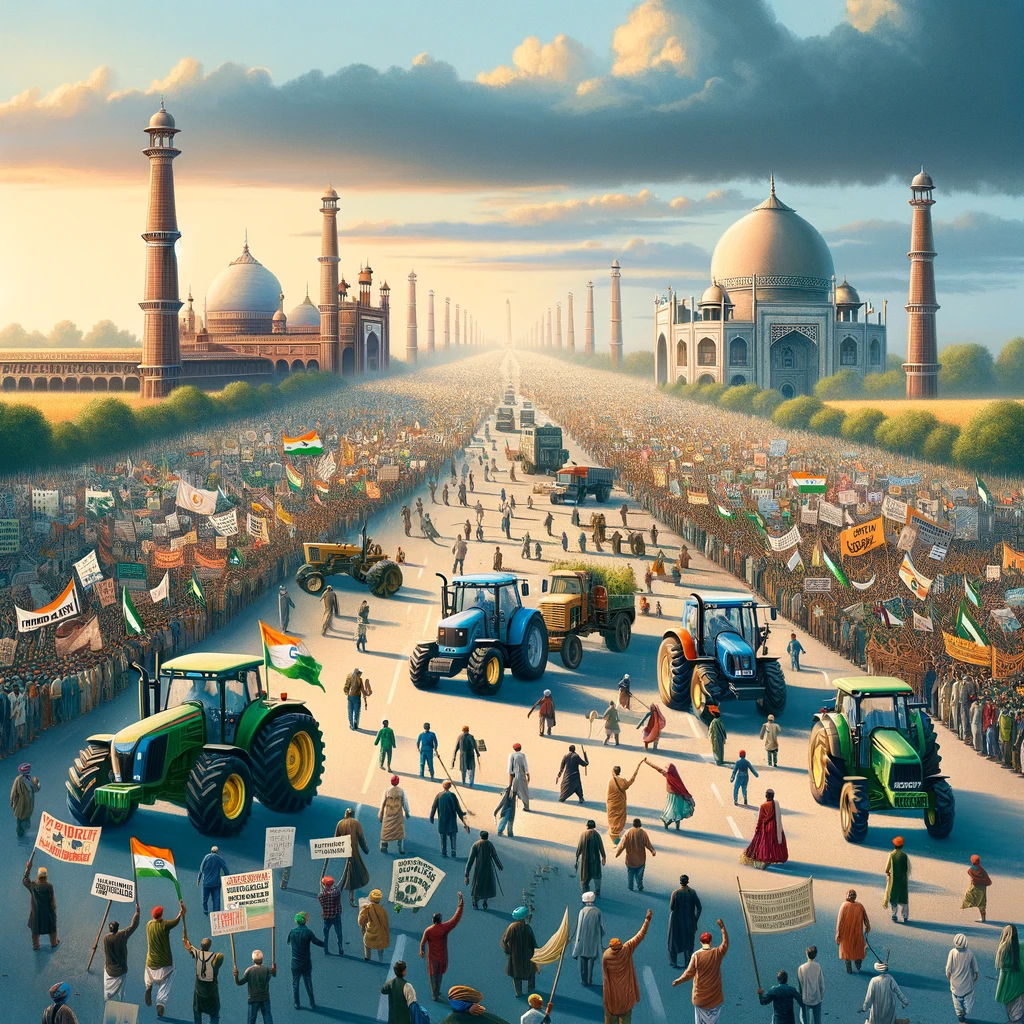
February 2024 witnessed a resurgence of protests in India’s agricultural sector, dubbed “Farmers’ Protest 2.0.” Initiated at the Shambu border between Haryana and Punjab, the movement resonates with farmers nationwide, encompassing a broad spectrum of demands echoing their call for justice, financial security, and comprehensive policy reforms. This renewed mobilisation reflects the ongoing struggle for a sustainable agricultural future and highlights the farmers’ unwavering spirit and determination.
Understanding the Roots of the Farmers’ Protest: From Legislation to Mobilisation
The spark for the 2024 protest can be traced back to September 2020, with the passage of three controversial farm acts that initially ignited widespread unrest, particularly in Punjab. While the government eventually repealed some aspects of these acts, unresolved grievances fueled this renewed mobilisation, emphasizing the need for fundamental policy shifts beyond mere symbolic gestures.
Core Demands: The Framework of the Protest:
1) A Legal Guarantee for MSP:
At the heart of the farmers’ demands lies the call for a legally enshrined Minimum Support Price (MSP) for all crops. This pivotal demand aims to ensure income security and fair pricing, providing a crucial safeguard against market volatility and exploitative practices. Farmers perceive the current system as inadequate, calling for a transparent and reliable mechanism to guarantee a remunerative income for their produce.
2) Debt Relief and Financial Support:
Farmers across India grapple with the burden of mounting debts accrued due to factors like crop failures, rising input costs, and volatile market conditions. A comprehensive debt waiver is seen as essential for immediate relief, alongside a demand for a pension scheme for elderly farmers, offering a safety net for those who have dedicated their lives to agriculture. Such measures are considered crucial in ensuring the long-term financial stability and dignity of farming communities.
3) Implementing the Swaminathan Commission’s Recommendations:
The Swaminathan Commission, formed in 2006, proposed a formula for calculating MSP that ensures prices are at least 50% higher than the weighted average cost of production. This formula is another key demand of the farmers, as it aims to provide a fair return on their investments and efforts, making agriculture a sustainable and viable livelihood option.
4) Withdrawal of Legal Cases:
Farmers also demand the withdrawal of legal cases filed against participants of the 2020 protests, seeking to clear the records of those who both peacefully and violently advocated for their cause which led to a riot-like environment in the national capital. This demand underscores a broader call for respect and recognition of farmers’ rights to protest and voice their concerns without facing repercussions.
5) Economic and Policy Reforms:
The protests resonate with demands for various economic and policy reforms aimed at enhancing financial stability and market access. These include increased minimum wages under the MGNREGA scheme, reduction in input costs like fertilizer and diesel prices, and compensation for crop losses due to natural disasters. These measures are perceived as crucial to alleviate financial pressures and ensure a level playing field for farmers.
6) Repealing the Electricity Amendment Bill and APMC Restrictions:
The protest voices opposition to the Electricity Amendment Bill 2022, which farmers perceive as a threat to affordable electricity access for farming activities. Additionally, they call for the removal of restrictions on Agricultural Produce Market Committee (APMC) mandis, advocating for freer market access and better bargaining power for farmers. These demands highlight the need for policies that empower farmers and promote equitable market participation.
7) Social and Institutional Reforms:
Farmers demand an investigation into alleged police brutality during the 2020 protests and the release of imprisoned farmers. This call goes beyond individual cases and represents a broader demand for social justice and accountability within institutions. Additionally, the demand for repealing the 2020 farm laws reflects deep-seated concerns over policies perceived as detrimental to farmers’ interests and a lack of transparent and inclusive decision-making processes.
The Road Ahead: Negotiations and Potential Escalations:
As the protest continues, with thousands of farmers camped at various border areas, the dialogue between farmers’ leaders and the government appears to be at an impasse. The future of the protest and its impact on policy reforms remains uncertain, with the potential for further escalation if resolutions are not reached. The success of the movement hinges on sustained public support, effective negotiation strategies, and the government’s willingness to address the core demands and engage in genuine dialogue.
Beyond the Immediate Demands:
While the current protest focuses on specific demands, it also sheds light on broader challenges faced by Indian agriculture. These include issues like climate change, land degradation, and the need for sustainable farming practices. Addressing these challenges necessitates long-term solutions that prioritize the well-being of farmers, ensure food security, and contribute to a sustainable and equitable agricultural future for India.
Economic Implications of the Protest:
The farmers’ protest holds significant economic implications for India. On one hand, the realization of their demands, particularly the legal guarantee of MSP, could stabilise agricultural incomes, thereby boosting rural consumption and contributing to economic growth. However, the financial strain of widespread loan waivers and increased government spending on agriculture could pose fiscal challenges. Balancing these demands with fiscal prudence will be crucial for India’s economic health.
International Eyes on India’s Agrarian Crisis:
Internationally, the protest has drawn attention to India’s agricultural policies and the broader issues of food security and farmers’ rights. Global solidarity movements and international media coverage highlight the interconnectedness of agricultural policies and global food systems. The international community’s support underscores the importance of addressing farmers’ grievances while navigating the complexities of global trade agreements.
Leveraging Technology for Agriculture:
Technology offers promising solutions to many of the concerns raised by the protesting farmers. From precision agriculture and digital platforms for transparent market access to blockchain for ensuring MSP compliance, technology can bridge gaps between policy intentions and on-ground realities. Innovations in agricultural tech can also empower farmers with real-time data on weather, soil health, and market prices, potentially transforming the agricultural landscape in India.
Environmental Sustainability and Agriculture:
The farmers’ protest underscores the urgent need for sustainable agricultural practices in India. The demand for environmental consideration in agricultural policies highlights the need to balance productivity with conservation. Practices such as crop rotation, organic farming, and integrated pest management not only address environmental concerns but also ensure long-term agricultural sustainability. The protest could thus serve as a turning point for incorporating green practices into India’s farming methodologies.
Navigating the Future with Informed Perspectives:
Quotes and insights from agricultural economists, policymakers, and environmental experts provide a roadmap for addressing the farmers’ demands while ensuring economic viability and environmental sustainability. Experts suggest that a multi-pronged approach, involving policy reforms, investment in agricultural technology, and a shift towards sustainable practices, is essential for resolving the current crisis and safeguarding the future of Indian agriculture.
Counterpoint:
Analysing the Political Undercurrents of the 2024 Indian Farmers’ Protest
The 2024 Indian Farmers’ Protest, marked by the rallying cry “Delhi Chalo,” has captured national and international attention. While the protest voices legitimate concerns over farmers’ welfare and agricultural policies, there’s an emerging dialogue suggesting that the movement may be significantly influenced by political agendas, casting a different light on the nature and implications of the protests.
The Question of Political Influence:
Critics argue that the protests are not purely grassroots movements driven by farmers’ needs but are substantially influenced by political entities aiming to destabilize the current government. This perspective posits that some demands, while appearing to champion farmers’ rights, may serve as vehicles for political parties to gain leverage against their opponents, potentially detracting from the objective assessment and implementation of agricultural reforms.
The Economic Rationality of Farmers’ Demands:
The call for an unconditional legal guarantee of the Minimum Support Price (MSP) for all crops is seen by some as economically unsustainable. Critics suggest that such policies could lead to fiscal imbalances, arguing for a more market-driven approach to ensure the agricultural sector’s competitiveness and sustainability. They advocate for reforms that balance farmers’ welfare with economic pragmatism, emphasizing the need for policies that foster innovation, efficiency, and global competitiveness in agriculture.
Navigating Between Welfare and Modernisation:
The perspective that views the protests as unfair argues for the necessity of agricultural reforms to modernize the sector, enhance productivity, and ensure food security in the face of growing domestic and global challenges. It suggests that resistance to reforms may hinder the agricultural sector’s evolution, potentially affecting India’s ability to meet its food security goals and maintain its position in the global agricultural market.
Addressing the Concerns Without Political Bias Through Dialogue:
To move beyond the impasse, this viewpoint emphasizes the importance of dialogue and collaboration between the government, farmers, and other stakeholders, free from political motivations. It calls for an inclusive approach to agricultural policy-making that considers the long-term sustainability of farming, market dynamics, and the overall economic health of the country.
Towards a Balanced Approach to Agricultural Reform
The narrative surrounding the 2024 Indian Farmers’ Protest is complex, with intertwined layers of economic policies, farmers’ welfare, and political dynamics. From this perspective, achieving a fair and sustainable future for Indian agriculture requires disentangling legitimate concerns from political agendas. It necessitates a balanced approach to reform that addresses the needs of the farming community while ensuring the sector’s economic viability and alignment with global best practices.
This alternative perspective offers a different lens through which to view the 2024 Indian Farmers’ Protest, highlighting the tension between political motivations and the pursuit of practical, sustainable agricultural policies. It underscores the importance of constructive dialogue and pragmatic policy-making in navigating the challenges facing Indian agriculture today.