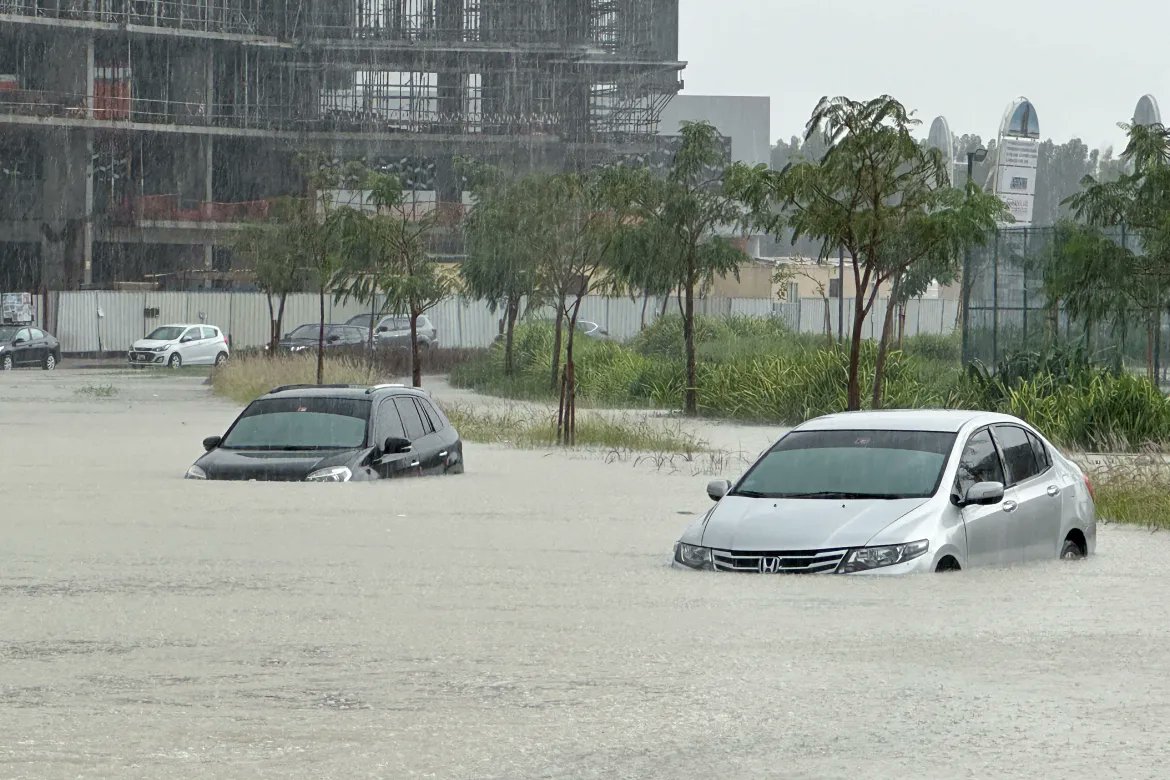
In the United Arab Emirates, a land where lavish skyscrapers meet the desert sands, making it rain is more than a metaphor—it’s a meteorological must. Recently, the UAE experienced what could be dubbed as its version of a wet surprise party. Last Tuesday, streets normally dusted with fine sand were suddenly washed with what was called the “heaviest rain ever” by the state-run WAM news agency. This historic deluge, surpassing any downpour recorded since 1949, turned the arid nation into an unexpected water world, with cloud seeding playing the role of a party planner.
What is Cloud Seeding? A Splash of History
The concept of cloud seeding is almost as dreamy as it sounds. Born from a mid-20th-century blend of science and a sprinkle of wishful thinking, it involves sprinkling substances like silver iodide or dry ice into clouds to encourage them to rain or snow. Vincent Schaefer, a chemist and a cloud enthusiast, could be considered the father of cloud seeding; he first made it snow in 1946 by tossing dry ice into a cloud from an aircraft. Since then, this technique has been tried from the mountain peaks of Wyoming to the bustling streets of Beijing, and now prominently in the UAE, where rain is more valuable than gold.
How Does Cloud Seeding Work?
Imagine being able to poke a cloud and make it rain. That’s cloud seeding in a nutshell. By introducing “seeding agents” like silver iodide or salt into clouds, scientists play matchmaker by helping water droplets find each other and get heavy enough to fall as rain. It’s not just about picking any old cloud; meteorologists play a real-life version of “Cloud Tinder,” swiping right on clouds that show the most promise for precipitation.
UAE’s Dance with the Clouds
The UAE’s tryst with cloud seeding began in the late 1990s, making it a pioneer in the Middle East. With the help of collaborators like the National Center for Atmospheric Research (NCAR) and NASA, the UAE has not just experimented with cloud seeding but embraced it as a saviour of its scarce water resources. The Emirates’ National Center for Meteorology reportedly conducted six to seven cloud-seeding flights before the recent historic rainfall, proving that when you can’t wait for rain, you make it happen.
Also read: India polio-free for a decade
The Cloud Seeding Ensemble
Behind the scenes of this atmospheric performance, the UAE operates a high-tech setup. Four Beechcraft King Air C90 aircraft, outfitted with the latest in cloud seeding tech, take off from Al Ain Airport. Their mission? To scan the skies with an arsenal of advanced equipment, ready to seed the clouds upon command. This is supported by a network of 86 automatic weather stations, climate databases, and high-precision weather predictions that make the UAE’s cloud seeding program one of the most sophisticated in the world.
Cloudy with a Chance of Caution
As the UAE and other nations continue to harness cloud seeding’s potential, the balance between human ingenuity and natural integrity remains delicate. The technology promises an oasis of benefits but also poses questions that require thoughtful stewardship and continued scientific scrutiny. Like any good party host knows, the key to a successful bash lies not just in throwing a great party but ensuring everyone leaves happy—even Mother Nature.
Cloud Seeding: Making It Rain with Science and a Bit of Alchemy
When humanity first gazed up at the sky, it was in wonder and reverence. Today, we still look up, but now with the audacity of trying to control the weather itself. Enter cloud seeding, the meteorological equivalent of a rain dance, but with more science and less dancing.
The Science of Squeezing Clouds
At its core, cloud seeding involves the introduction of particles into clouds to encourage precipitation. The principle is simple: water vapor needs something to cling onto in order to condense into raindrops. Silver iodide and sodium chloride (table salt, if you’re not into the whole chemistry vibe) are the go-to particles for playing matchmaker in this high-altitude dating scene.
The process can be executed by plane or by ground-based generators that might make you think of anti-aircraft defences, only friendlier. Planes are typically used for the ‘glaciogenic’ method, where silver iodide induces the freezing of supercooled water droplets in the cloud. Ground stations often use the ‘hygroscopic’ method, flinging salt to encourage water droplet growth, hopefully leading to a lovely downpour.
Cloud Seeding: The World Tour
From the mountainous terrains of Wyoming to the arid landscapes of the United Arab Emirates, cloud seeding has been attempted with varying degrees of success. China has a robust cloud seeding program, using the technique to clear the air or ensure the ceremonial sun shines on parades. India has experimented with it to address drought conditions, while regions in the U.S. like California and Texas have sprinkled (more puns!) it into their water management strategies, especially during periods of water scarcity.
Not All Sunshine and Rainbows
However, like a Hollywood rain scene that unexpectedly turns into a storm, cloud seeding comes with its share of controversy and environmental concerns. Introducing foreign agents into the atmosphere doesn’t just mess with cloud chemistry—it could potentially alter entire ecosystems. The process might affect natural hydrological cycles, changing soil moisture levels, groundwater recharge, and river flows, which can have long-term impacts on local environments and agriculture.
Moreover, there’s the glittery elephant in the room: silver toxicity. Although the amounts of silver iodide used in cloud seeding are small, the cumulative effects could be significant, posing risks to aquatic life and soil health over extended periods. It’s not just about making it rain; it’s about ensuring we’re not raining down ecological disturbances.
Cloud seeding, for all its potential to mitigate drought and enhance water supplies, remains a topic of heated debate. The question isn’t just whether we can make it rain but whether we should, and how often. It’s a classic case of scientific ability racing ahead of ethical considerations. The responsibility lies in managing this technology with a careful balance of ambition and prudence.
Responsible stewardship means a thorough evaluation of environmental impacts, transparent reporting of results, and a willingness to pull back when unintended consequences start clouding the benefits. After all, in our quest to play Zeus, we must ensure we’re not inadvertently playing the villain in our own ecological narrative.
So, as we advance our capabilities to coax showers from the skies, let’s remember that with great power comes great responsibility. After all, in the quest to control the weather, it’s important to ensure we’re not left with a climate hangover we can’t cure. Because when it comes to messing with Mother Nature, we’d best tread lightly and carry a big ethical umbrella.