
NASA's Voyager 1 reaches one light-day from Earth after 49 years of travel
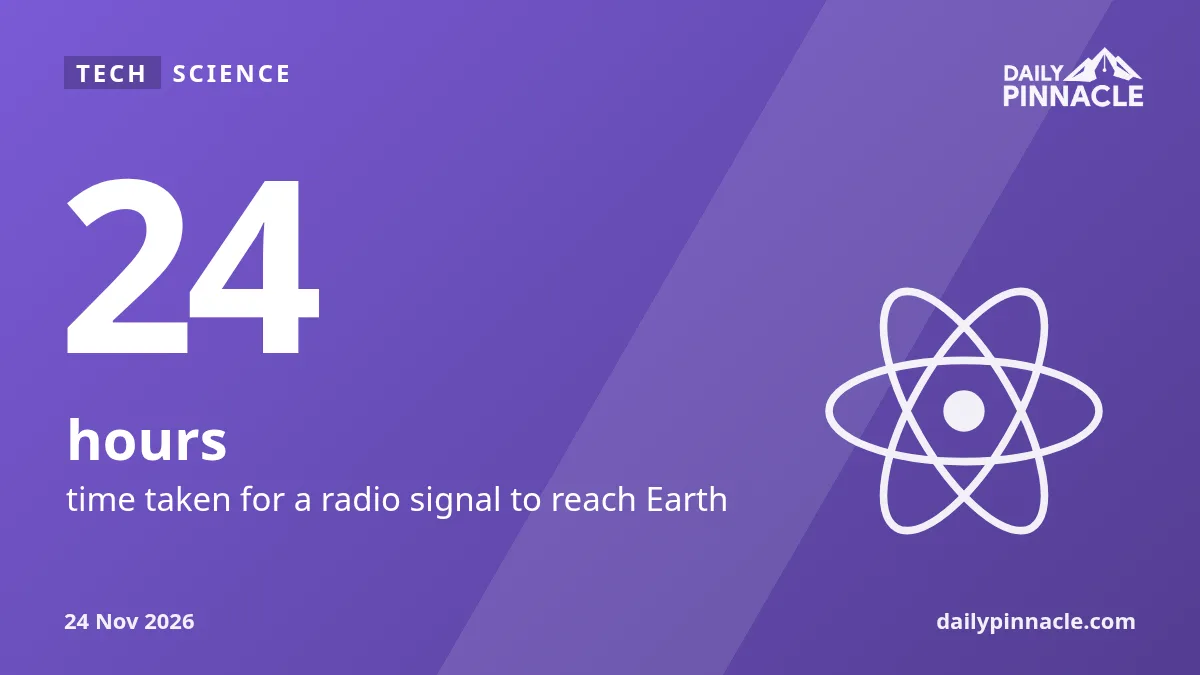
The spacecraft sent a signal that took exactly 24 hours to reach Earth, marking a historic milestone in space exploration.
NASA's Voyager 1 has reached a distance of one light-day from Earth, according to reports from The Hindu and WION. The spacecraft achieved this milestone on November 18, sending a radio signal that took exactly 24 hours to reach Earth at the speed of light.
The distance of one light-day is approximately 16.1 billion miles or 25.9 billion kilometres. This distance represents the space light covers in a full 24-hour period. Because of this distance, any radio command sent from NASA's Deep Space Network to the probe will now take 24 hours to arrive, with another 24 hours required for the response to return.
NASA's Heliophysics Division Director Joe Westlake said that travelling a light-day is a singular feat for a spacecraft. Jet Propulsion Laboratory (JPL) Director Dave Gallagher described the crossing of the light-day threshold as a historic feat on an extraordinary voyage of discovery.
Launched in September 1977, Voyager 1 was originally designed for a four-year mission to study Jupiter and Saturn. It became the first human-made object to enter interstellar space in August 2012. The probe has previously discovered new moons and ring systems around Jupiter and Saturn.
Microsoft AI CEO Mustafa Suleyman praised the mission on X, noting that the probe was built with 1970s technology and is still calling home. While Voyager 1 has reached this milestone, NASA expects Voyager 2 to reach the one-light-day distance in November 2035.